
What is hyperautomation: it is the strategic approach that combines multiple technologies, including artificial intelligence, RPA, process mining, and document automation, to automate entire business processes end-to-end, not just isolated tasks.
Hyperautomation is a discipline coined by Gartner that describes the coordinated orchestration of multiple automation and artificial intelligence tools to automate as many business processes as possible. Unlike "siloed" automation, which solves a single task, hyperautomation aims to digitize the complete flow - from the arrival of a document all the way to writing the data into the system and triggering the next action.
For years, business automation grew in a fragmented way: a piece of software for invoicing, a macro to export data, a robot that copies information from a portal, an integration here and there. Each tool handles its own piece well, but the overall picture remains an archipelago of islands of efficiency separated by moats of manual work. Hyperautomation is the answer to this fragmentation: instead of automating yet another single task, it aims to automate the process as a whole, turning a collection of disconnected automations into a single fluid, "intelligent" chain.
The term was popularized by Gartner, which listed it for several consecutive years among the top strategic technology trends. It does not describe a product to buy, but a direction: using everything technology has to offer - artificial intelligence, software robotics, process analysis - in a coordinated way to minimize manual intervention across the entire work cycle. It is a concept that applies to a multinational just as much as to a small business: the scale and the tools change, not the underlying principle.
What Is Hyperautomation?
Hyperautomation is not a single technology, but a strategy. It consists of systematically identifying everything in the organization that can be automated and using the most suitable set of tools to do it, making them talk to each other. Where classic automation asks "how do I automate this task?", hyperautomation asks "how do I automate the entire process, including the decisions and the exceptions?".
The leap in quality lies in adding intelligence. A traditional robot can copy a number from one cell to another, but it stops in front of a messy PDF or an email written in natural language. Hyperautomation brings in AI precisely to handle this "grey matter": understanding unstructured documents, interpreting context, making decisions, and handing over to a human only the exceptions that genuinely deserve human judgment.
The Technologies Behind Hyperautomation
Hyperautomation is not a tool, but a stack: multiple technologies arranged in collaborating layers. It helps to read them as four stacked layers - discover, understand, act, orchestrate - where each layer passes its result to the next.
1. The layer that discovers: Process & Task Mining
Before automating, you need to know what to automate, and with objective data rather than gut feeling. Process mining reconstructs the real flow of a process from system logs (who does what, in what order, with how many delays and reworks); task mining observes operators' actions on the desktop. Together they reveal bottlenecks, recurring exceptions, and the highest manual-cost steps - that is, the ideal candidates for automation and the order in which to tackle them.
2. The layer that understands: AI, Machine Learning, and IDP
This is the real leap compared to classic automation. Here live the models that interpret unstructured input and make micro-decisions:
- Intelligent Document Processing (IDP): the AI that "reads" and understands unstructured documents (PDFs, scans, emails, photos), extracting structured, ready-to-use data. It is the system's sense of sight, and in practice the component that unlocks most processes.
- Machine Learning and predictive models: they classify (e.g. what type is this document?), predict (e.g. is this payment at risk?), and improve with use, learning from operators' corrections.
- Generative and conversational AI: it summarizes text, answers questions, routes requests in natural language, and acts as the interface between people and automated processes.
3. The layer that acts: RPA and application automation
Once the data is clear, something has to perform the action. RPA (Robotic Process Automation) consists of "software robots" that replicate repetitive operations across interfaces and systems: data entry, clicks, file movements - especially useful when a legacy system exposes no API. Where APIs do exist, direct application automation is more robust and faster. These are the hands of the system: without the layer that understands, however, they remain blind.
4. The layer that orchestrates: integrations and BPM
This is the conductor. Orchestration platforms (iPaaS, BPM engines, workflow engines) and APIs coordinate the various tools, define the sequence of steps, handle decision branches, route exceptions to the right people, and move data between ERP, CRM, and business systems. Monitoring also plugs into this layer: dashboards and KPIs that close the loop, feeding back into process mining to understand where to automate next.
The practical rule: none of these layers, on its own, is hyperautomation. Value emerges when the layer that "understands" feeds the one that "acts", under the direction of the one that "orchestrates" - and everything is measured to improve over time.
Hyperautomation vs Traditional Automation (RPA)
Understanding the difference is the best way to avoid disappointing investments. Traditional automation, based on RPA alone, is powerful but brittle: it works as long as the data is already structured and the rules never change.
- Traditional RPA: automates a task. It replicates an operator's steps on already-ordered data. If the input changes format or an exception arrives, the robot gets stuck.
- Hyperautomation: automates an end-to-end process. It combines AI understanding (to handle variable, unstructured input) with RPA execution and orchestration, also managing exceptions through Human-in-the-Loop logic.
RPA alone automates what already works on fixed rules. Hyperautomation also automates what requires "understanding" - and that is where most of the remaining manual work hides.
Why It Matters: The Business Benefits
Adopting a hyperautomation approach is not a purely technological choice, but a concrete competitive lever. For any organization with administrative and operations teams under pressure, the benefits are tangible:
- Elimination of manual data entry: data is no longer rekeyed by hand but flows automatically between systems, eliminating careless errors.
- Speed and scalability: processes are completed in minutes rather than days, and the company can handle growing volumes without hiring staff just to "type data".
- Lower operating costs: the hourly cost of internal bureaucracy drops sharply, freeing up resources for higher-value activities.
- Empowered people: skilled staff stop doing "digital heavy lifting" and focus on control, customer relationships, and handling anomalies.
- Reliable, real-time data: a faster cash cycle, always-aligned inventory, and decisions based on up-to-date data rather than last week's spreadsheets.
How to Implement It: A 6-Step Roadmap
The guiding principle is just one: "Start small, scale fast". Hyperautomation isn't bought and switched on: it's built in successive layers, validating the value on one process before extending it. Here is a pragmatic roadmap, designed to reach a measurable result in weeks, not years.
- Map the processes and pick the target (weeks 1-2). Use process and task mining - or even just interviews and direct observation - to find where manual work concentrates. Look for the point of maximum friction: high volume, lots of data entry, frequent errors, fairly stable rules. Typically it's the handling of inbound documents.
- Define the "end-to-end" process, not the task. Map the whole flow from the triggering event (e.g. an email with an order arrives) to the final result (e.g. order recorded in the system and confirmation sent). Set success metrics from the start - cycle time, cost per document, error rate - so you can prove ROI.
- Start with understanding the data (IDP). This is the step most projects get wrong: they start from the "robots", forgetting they work on dirty input. Introduce document automation first to turn unstructured input into clean, validated data. Without structured data, every downstream automation is unstable.
- Integrate with existing systems. Connect the extraction to your business systems and ERP, preferring APIs where they exist and RPA only where a legacy system leaves no alternative. The goal is for data to reach its destination with no human copy-paste (Odoo, Microsoft Dynamics, SAP, Sage...).
- Keep the human in the loop (Human-in-the-Loop). Don't aim for 100% automation right away: set confidence thresholds below which the document or decision passes to an operator. The AI handles the bulk flow, the person approves only the exceptions - and every correction trains the system, raising accuracy over time.
- Measure, consolidate, and expand. Compare KPIs against the initial baseline, stabilize the first process, then replicate the same model across the other flows. That's how automation goes from a pilot project to true, widespread hyperautomation.
The most common mistakes to avoid: starting from a process that is too big or unstable; automating an inefficient flow without rethinking it first ("don't automate the chaos"); relying on RPA alone for unstructured input; and forgetting monitoring, which is what makes automation maintainable rather than fragile.
The Ideal Starting Point: Document Automation
If hyperautomation is the destination, document automation is almost always the first step of the journey. The reason is structural: most of the remaining manual work in any organization hides in inbound documents - supplier invoices, orders in PDF, scanned delivery notes, contracts. This is data "trapped" in unstructured formats, and as long as it stays that way, no RPA robot or integration can truly process it. It is the real bottleneck: the layer that "understands", described earlier, is almost always the first one missing.
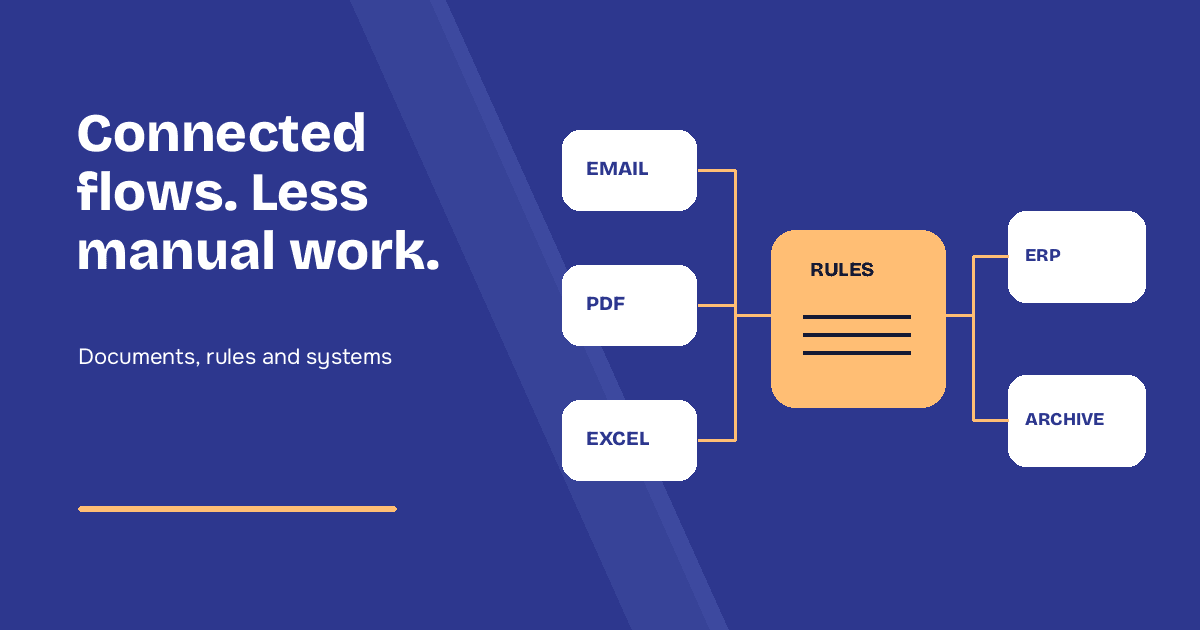
It's worth seeing it as a concrete flow. Imagine a customer order arriving by email, attached as a thirty-line PDF. In a non-automated company, an operator opens the email, downloads the file, reads it, and retypes every line into the system. In a hyperautomation chain that starts from document automation, instead, this is what happens:
- Capture: the system automatically intercepts the email and the attachment, without anyone opening the inbox.
- Understanding (IDP): the AI classifies the document as an "order", extracts the header, item codes, quantities, and prices, and normalizes them against the company's master data - even if that customer's layout differs from every other one.
- Validation: business rules and cross-checks verify the data (does the code exist? is the price in line?). If confidence is high, it proceeds; if something doesn't add up, the document goes into a Human-in-the-Loop queue where an operator confirms it in seconds.
- Execution and orchestration: the validated order is written into the ERP via API, the confirmation is sent to the customer, and the next steps are triggered (stock availability, fulfillment). The clean data feeds the entire downstream chain.
It is exactly the building block that "gives eyes" to the whole system: it turns unstructured documents into data ready to be orchestrated by the rest of the hyperautomation. That's why it almost always makes sense to start here - high volume, fast ROI, and no dependency on rebuilding your entire software stack. To dive deeper into how it works, read our guide to OCR and AI document processing, or discover how to automate invoices in SMEs.
Conclusion
Hyperautomation is neither a passing fad nor a luxury reserved for multinationals: it is the natural evolution of a digitization effort that, far too often, has stopped halfway. Receiving a PDF instead of paper isn't enough; you need to make data free, structured, and capable of setting processes in motion on their own. The companies that start today to orchestrate AI, document automation, and integrations - beginning from a single concrete process - build a competitive advantage that is hard for those still tied to the keyboard to close. The best way to approach hyperautomation is to start small, at the point of maximum friction, and scale fast.