
In the world of document management, you often hear about OCR, AI parsers and tools that promise to "extract data" from invoices, orders, delivery notes, contracts and much more. But the real problem is not just reading the text: it is truly understanding what it means, placing it in the right context and using it reliably in business processes.
This is where TypeLens comes in: not a simple OCR, not just another "smart parser", but a document understanding and validation engine based on agents and workflows, designed to go far beyond the classic "if/else" and "query == value" paradigm.
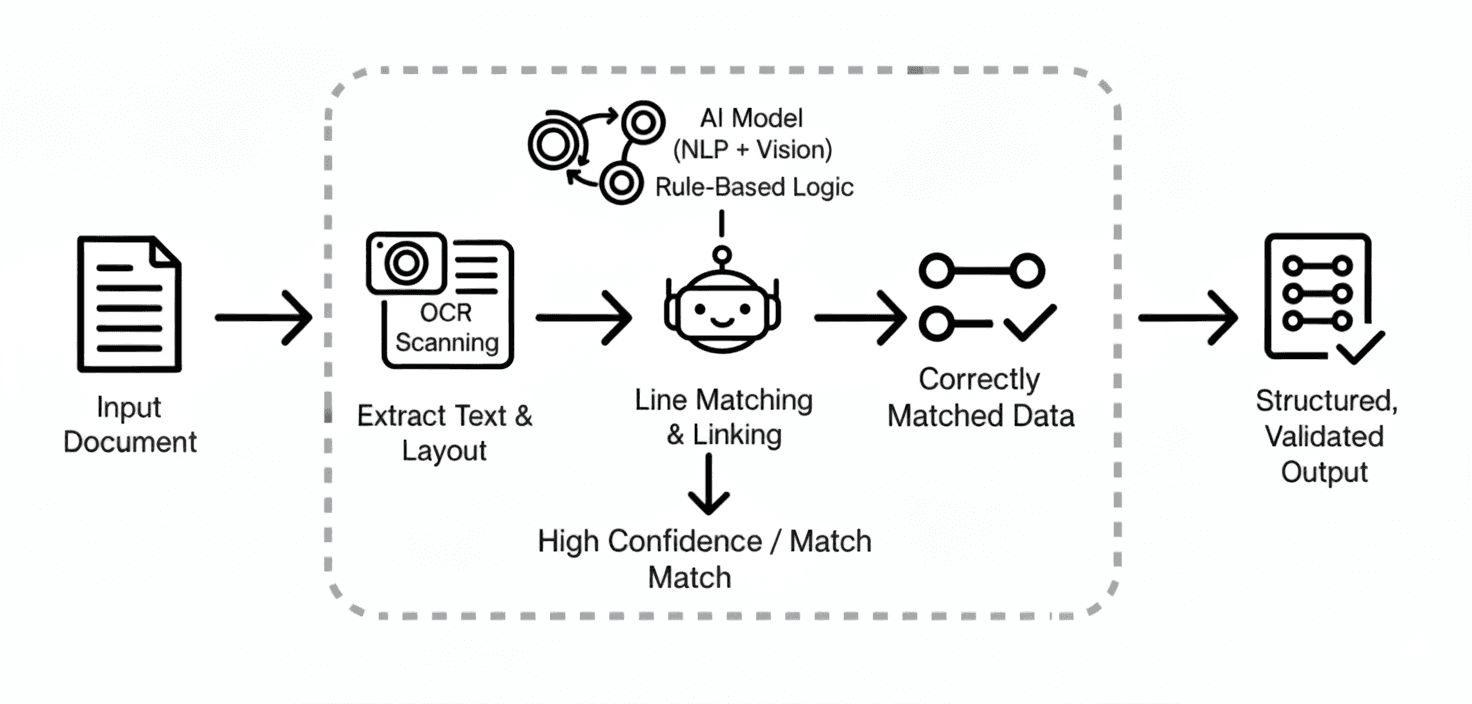
The limits of traditional systems: OCR + rigid rules
Most systems on the market work like this:
- OCR: reads text from images or PDFs and converts it to digital text.
- Parser / Rules: a series of rules, usually:
- Nested if/else
- Database queries of the type
field == value - Fixed patterns (regex, positions, templates)
This approach has some evident limitations:
- Fragility: a small variation in document layout or in how a field is written is enough to break the rule.
- Lack of context: the system doesn't "understand" what it's reading, it simply compares strings.
- Poor ambiguity handling: a supplier written differently, an incomplete code, a missing field often mean errors, rejections or manual interventions.
- Limited scalability: every new format or case requires new rules, with growing costs and continuous maintenance.
In summary: these systems read, but don't understand.
What TypeLens Does Differently
TypeLens starts from the same base (OCR and parsing), but surpasses it through three key elements:
- An AI-enhanced OCR
- Intelligent agents working in coordinated workflows
- Contextual matching rules, not rigid ones
In practice, every document is not just "read" but interpreted, enriched, checked and, when needed, automatically corrected, taking the entire available context into account.
OCR + AI: reading is just the first step
OCR in TypeLens is not the destination — it is the starting point. For a deeper look at how OCR accuracy is measured and improved, see our OCR accuracy guide.
- Converts the document into structured text.
- Identifies logical blocks (headers, tables, footers, notes).
- Recognises typical patterns (dates, amounts, IBANs, tax codes, order references, etc.).
This is where AI agents come in, taking the "raw" OCR result and transforming it into usable, consistent and verified information.
Agents in workflow: how it really works under the hood
In TypeLens, work is not entrusted to a single monolithic engine, but to multiple specialised agents, organised in a workflow.
Each agent has a precise role:
- One agent specialises in recognising the supplier/customer.
- Another in validating amounts, VAT, totals.
- Another in linking the document to an existing order, contract or shipment.
- Another can verify consistency between multiple fields (e.g. total = sum of lines, correct VAT regime, etc.).
These agents:
- Share information with each other: if one agent identifies the supplier, the others use this data as context.
- Make decisions in sequence: the result of one agent influences the behaviour of the next.
- Circle back when needed: if a consistency check fails, the workflow can re-analyse the document with a different strategy.
The result is a workflow that resembles the reasoning of a person much more than a series of if/else scattered through code.
Not just reading data: correcting and completing it
One of the most important points is: TypeLens does not simply read what it finds on the document.
Thanks to context and agents:
It recognises missing or incomplete data
- An order number written partially
- A description that doesn't clearly specify the product, but is sufficient to trace it back to an item in the registry
It identifies misleading data
- A supplier with a different trade name but the same tax code
- An IBAN that has been changed but not yet updated in internal systems
It proposes and applies corrections
- Normalises names (company names, date formats, codes)
- Standardises units of measure, currencies, internal codes
This is possible because TypeLens rules are not simple "query == value" comparisons, but models that take into account similarities, context, history and consistency with the rest of the company data.
From Rigid to Contextual Matching
In traditional systems, matching often works like this:
- If
supplier == "ALPHA LLC"then associate with registry X. - If
order_code == "123456"then link to order 123456 in the ERP.
A single extra character, a space or a name variant is enough to break the rule.
In TypeLens:
The supplier is identified by comparing multiple signals:
- Name/company name (even if not perfectly identical)
- Tax code / VAT number
- Address and contact references
- History of previous documents
The order is found by evaluating:
- Order number similarity (including variant formats)
- Compatible dates and amounts
- Connections with involved suppliers or customers
- Information present in the ERP
In this way, matching becomes precise but flexible — much closer to how an experienced operator reasons than to a literal query engine.
Practical Example: an "Imperfect" Invoice
Imagine an invoice with these issues:
- The supplier name is written as "ALPHA LLC UNIP." instead of "ALPHA L.L.C. UNIPERSONALE".
- The order number shown is "ORD-8945" while in the ERP it is "PO-00008945".
- One of the lines has a vague description, but quantity and amount are consistent with a known item.
- The IBAN is written with an extra space and an OCR-ambiguous character.
A traditional system might:
- Fail to recognise the supplier or create a duplicate.
- Fail to correctly link the invoice to the order.
- Fail to associate the line with any item, leaving it "free".
- Require manual checks or generate accounting errors.
With TypeLens, the agent workflow:
- Identifies the supplier by cross-referencing similar name, VAT number and document history.
- Finds the correct order using different patterns to compare "ORD-8945" with "PO-00008945" and verifying date/amount.
- Interprets the line considering context, description, quantities and amounts, proposing the mapping to the most probable item.
- Normalises the IBAN, correcting formatting and ambiguously interpreted characters.
The result is a document read, understood, validated and enriched — ready to be posted or integrated into downstream processes with minimal or no manual interventions.
Advantages for the business: beyond automation, reliability
This architecture based on agents and contextual matching delivers concrete benefits:
Drastic error reduction
It is not just about "automating data entry", but about improving data quality compared to manual typing.
Fewer exceptions and manual checks
Fewer cases to "handle manually", fewer bottlenecks in administrative or logistics offices.
Scalability to new formats and suppliers
New layouts, new partners, new languages are handled much more easily, without rewriting dozens of if/else rules.
More consistent and usable data in internal systems
ERP, CRM, accounting and BI systems receive already clean and consistent data, ready for analysis, reconciliations and reports.
Faster response time
Intelligent workflows operating in parallel enable fast processing, even with high volumes of documents.
In summary: why TypeLens is "much more" than an OCR or AI parser
When talking about document management, it is easy to fall into the trap of thinking that simply "reading" documents is enough. But the real challenge is not optical recognition: it is understanding the meaning, validating consistency and reliable integration into business systems.
TypeLens goes beyond the very concept of OCR or traditional AI parser:
- It's not just OCR:
It reads the text, but above all it interprets it and links it to existing business data, creating intelligent connections between document and context. - It's not just an AI parser:
It does not merely extract fields, but validates them, autonomously corrects them and enriches them with information from your management systems. - It doesn't just use if/else or query ==:
It uses specialised AI agents working in coordinated workflows, capable of reasoning about context, handling ambiguity and making complex decisions as an experienced operator would.
The real difference of TypeLens
TypeLens transforms documents from simple "text containers" into structured sources of reliable and verified information, perfectly integrable into the company's digital processes. We are not talking about automation as an end in itself, but about superior data quality compared to manual entry, with time reduced to zero and unlimited scalability.
If your company's objective is to go beyond simple digitization and aim for intelligent automation, certified data quality and real scalability, then TypeLens is not simply an alternative to traditional OCR or AI parsers on the market.
It is a true paradigm shift in document understanding: from passive extraction to active validation, from mechanical reading to contextual comprehension.